Labels

Showing posts with label sharing research. Show all posts

Tuesday, September 30, 2014

Inquiry Based Learning

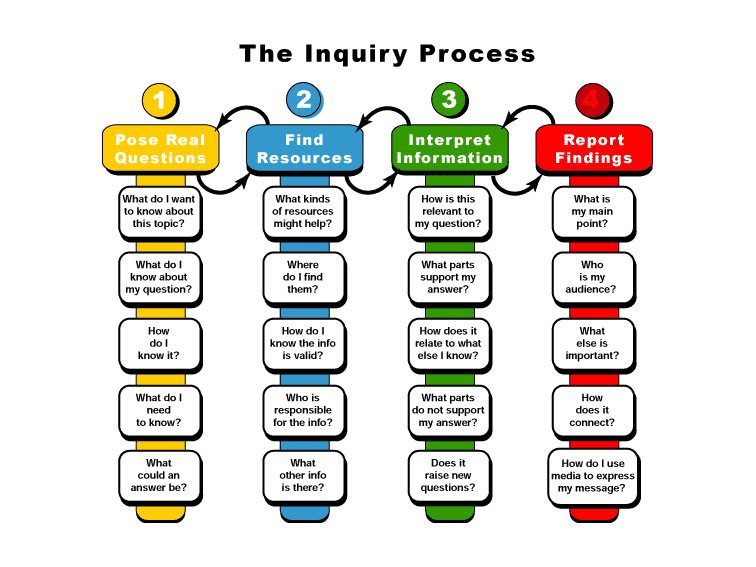
Great Post over at Te@achthought about questions that can guide student research at any stage:

http://www.teachthought.com/learning/20-questions-guide-inquiry-based-learning/


20 Questions To Guide Inquiry-Based Learning


You really need to READ the article in order to understand what they have created and why.  Then,save this FABULOUS Graphic they created.

20-questions-to-guide-inquiry-based-learning


Wednesday, May 14, 2014

Kids don't read anymore?

Frank Bruni's May 12th Opinion page article in the NY Times http://www.nytimes.com/2014/05/13/opinion/bruni-read-kids-read.html?hp&rref=opinion&_r=1
has me thinking about WHY kids don't read anymore! While Bruni eloquently talks about Common Sense Media's report, I wonder WHY fewer than 20 percent of 17-year-olds now read for pleasure “almost every day!”  According to Common Sense Media, back in 1984, 31 percent read for pleasure almost every day.
YIKES is my first thought!  Yet, this study does not talk about the WHY?  A zillion WHY questions are playing in my head. 
  • What happens to kids when they read every day for pleasure when they are younger?
  • Did these kids read every day for pleasure when they were younger?
  • If so, when did the reading decline?  When did it end? 
  • What happens when kids are read to every day by parents?
  • What happens when kids are read to every day by teachers?
  • Did these parents and caregivers read to theses children?
  • If so, what kinds of books did they read?
  • Did they discuss the books?
  • Were these kids "forced" to read just right books rather than texts they wanted to read?
  • Were they "forced" to read certain genre books?
  • Were their choices (comics, newspapers, sports) embraced?
  • Were these kids forced to do reader responses?
    Were these kids forced to keep reading logs?
  • Where there books in their homes growing up?
  • Did their parents model reading?
  • Was reading valued in the same way sports and grades might be?
  • Was reading the subject of family discussions?
  • Did their parents see reading as a way of opening doors?
  • Do the young adults see reading as valuable or enjoyable?
  • What roles do teachers, parents, caregivers serve as reading models?
  • Do kids read for pleasure in school?
  • Do kids have time to read for pleasure?
  • Do they consider school mandated reading as pleasurable?
  • Do kids consider reading newspapers and Twitter reading for pleasure?
  • Are today's kids too cool to read?
HOW SAD was my next thought and yet I really wasn't all that surprised.  I thought about how busy our youth are with grades, sports, clubs and all the notches they need to put on their belts to get into the "right" schools.  I thought about ALL the homework That takes LOTS Of time.  I thought about afterschool, karate, dance, baseball. ballet, Brownies, Cub Scouts, swimming classes, playdates, the need to make the travel soccer team and the desire for our kids to be fit.  I also thought about Minecraft, Ipads and other video games....but only at the end. 


HOW IMPERITIVE it is that we research and find out the answers....because I really suspect there are more than one answers to the question.
Why don't kids read anymore?

Monday, December 9, 2013

#SOL2103 Ice, snow, and debit cards.

When the next day is a school day and the forecast is for ice, sleet, or snow, I park at the bottom of my driveway.  I accept my husband's teasing that I am a "Worry Wart" and the name calling, "Wimp," as part of the price I pay to NOT drive down my long and windy driveway on dark, icy mornings.   Yesterday, was one of those days as the driveway had a thin cover of sleet over a thick coat of ice over a delicate layer of snow!  There was no way ANYONE was driving or even walking down that incline and I was grateful for my parking spot at the bottom of the cliffs.  Yet, my coat, boots, gloves and even my undies were drenched after sliding (on my bum as the kids would say) down most of the hill.   

I felt as if I had already done a day's labor when I finally made it to my ice-ensconced car!  I gingerly opened the doors, started the engine and began the ice removal process.  As I got out to work on the windshield, I realized I had forgotten an ice scraper!  I wondered if the job was too big for my credit card. Yet, I'd used it before.  It works remarkably well in this situation - most of the time!  This time, however, the card did not fare so well.  With one swipe on the icy window, it turned into many fractured pieces of plastic.

Fortunately, the main roads were generously salted and lots of people were late; thus, my trip was really not that bad. When I finally I got to work and eventually dried off (it took all day), I was left with questions about whether or not I would be driving up the driveway any time soon (fortunately, thanks to my husband and rock salt, I did). 

Fortunately, there was only one casualty yesterday morning: my debit card.  I ordered a new one and I also put a big, heavy duty ice scraper into my trunk!

Friday, November 29, 2013

Leveled Books in a Common Core World

Many times, I've wondered about an overreliance on leveled texts.
I've pondered if we should sometimes let kids struggle because they want to read a book even if it is a major stretch.
I've wondered if the CCSS's admonishment of leveled texts is a bit of a "self correction" on a course we have taken that might contribute to a new controversy.
I'm aware of the research, albeit controversial, shared by Timothy Shanahan suggesting kids actually make better progress in the frustration level books!
http://blog.mcrel.org/2013/05/balancing-the-common-core-leveled-readers-vs-complex-text.html

Yet,
I've leveled many a book for my own guiding of students towards material that is assessable but not frustrating, material that is at their "instructional level" so to speak in the balanced literacy vernacular.  I cannot imagine discontinuing this practice.
I've guided many a student towards more assessable and thus more enjoyable reading material that was "at" or even well "below" their assessed reading level for independent and home practice. I cannot imagine discontinuing this practice.
I've encouraged many a parent to accept rereading of familiar and easy texts for fluency and fun.in the end, texts that are matched to students’reading levels AND interests are important to build competent and fluent readers. I cannot imagine discontinuing this practice.

So from my perspective,
I'm taking the middle road, like Susan Ryan and referring to the fluency aspect of  Foundational Skills as I encourage self-selected texts matched, at least somewhat, to their level.
I'm looking at levels as a piece of the puzzle that supports fluency, phrasing, and enjoyment.
I'm encouraging self selection of texts at all levels.
I'm looking for high quality, classic texts that are engaging while not abandoning the wonderful world envisioned by 21st Century authors such as Mo Willems and Kate Messener!


Saturday, April 20, 2013

Teach Hub: Information, graphics and inspiration

I've been viewing and using bits and pieces from Teach Hub for a while now http://www.teachhub.com/news. 

I realize National Library Week (April 14-20th) technically ends today; however, this great infographics from Teach Hub (one of my new favorite sites) is pretty neat and the information contained in it is worthy of our reflection as we plan for instruction during the other 51 weeks of the year too!  They said to feel free to share their graphic so I am sharing it here; however, I strongly suggest you visit the source for a better view! 


Teach Hub has great short video clips that I am using to help my students look closely at their environment from the perspective of litter. The video was a powerful discussion starter and led off the mini writing unit. Even if you, like me, didn't really get National Library Week off the ground for your kids, there is always hope for Earth Week resources over at Teach Hub!

While I admit that I find the "slowness" of the site frustrating, when I finally get where I want to go I am always grateful I waited for the site to load! Mostly, I find the site the be a source of ongoing professional development. 

Thursday, December 27, 2012

Education Research: Merit Pay, Charter Schools and Value Added Models

What we did and didn’t learn from education research in 2012
This Washington Post article http://www.washingtonpost.com/blogs/answer-sheet/wp/2012/12/23/what-we-did-and-didnt-learn-from-education-research-in-2012/?wprss=rss_answer-sheet popped up on my Twitter PLN feed the other day while I was in the middle of holiday preparation and case study reviews. I knew I wanted to revisit it because of the subject, education research.   The article,  by Matthew Di Carlo, senior fellow at the non-profit Albert Shanker Institute was originally online at http://shankerblog.org/?p=7300
 
While you should read the whole article, there are a couple of areas that are worth noting as at least I rarely read about education research about teachers!  Much of this year's research was on three “core areas” – merit pay, charter schools, and the use of value-added-growth-models in teacher evaluations. 
  1. In the area of merit pay, cconsistent with prior research, there were no discernible effects on testing outcomes with individual or school-wide bonus programs; but, there was some impact on teacher retention.
  2. In the area of charter schools, looking at the mechanisms that contribute to inconsistent performance of these schools is critical, not only for guiding the authorization of new charters, but also, more importantly, for improving all school.
  3. In the value-added model in teacher evaluations – 2012 might be remembered as the year in which a second batch of teacher-level value-added scores were published in a major newspaper. they had in their classes.  It is interesting to me that there IS a LOT of research going on in this area; yet nothing, so far, is a clear model.  (see here and here, here, here, and here, for example).


Saturday, November 24, 2012

CCS: We all need to know about it

For a while now, the words COMMON CORE STANDARDS have been sneaking into educational conversations.  "They're coming," whether or not we like it is the message I retained.  Yet, I want to know what they mean on all levels so that I can be sure I am advocating for students, teaching, and learning within the standards.  If we know what they mean, we can most effectively implement the changes in a proactive manner rather than just consuming programs and assessments because they say CCS on the package! I really have had to do a lot of research to figure out exactly what they mean for me and for the students and teachers I interact with every day. 

This article, on Edutopia, originally published earlier this month, has great links!
http://www.edutopia.org/common-core-state-standards-resources

I suspect that ASCD will be an important place to follow the implementation of Common Core State thanks to a grant from the Gates Foundation as it has developed a Common Core resource page (11) with alot of information, and plans for ongoing meetings and study.  There is even a hash tag to follow on Twitter at #ASCDcore (13).

The Hunt Institute's YouTube channel (14) is another place to go.  . "Shaping rigorous, world-class education standards" (15) is one of the Hunt Institute's (16) most famous.

As you get ready for lesson plans and other "down to earth" planning, check out Share My Lesson (25) and Common Core State Standards information center (28).

There were a many other links suggested in this Edutopia article including:

Saturday, November 17, 2012

Opening Minds: It's NOT just for teachers


Peter Johnston's Opening Minds has been ON MY MIND.  It was a required text this semester; however, I am confident my students did not find it nearly as thought-provoking as I did!   Truth be told, this fall, I have thoughts of Peter sitting behind me with a notepad "critically" recording my conversations with kids! 

Perhaps the dichotomy grows from the slow pace of the book  I did wonder if Johnston took an "article" and stretched it!  It is also possible that differences grow from my own very critical view of my own professional and personal interactions! Admittedly, I usually reflect on what I could do better rather than on what went well in a lesson or even in a parent conference! 
Admittedly, I usually think about how I might have interacted more effectively with friends and family. 

I am reflecting on this book as someone whom interacts with lots of children and parents.  Even in a theoretical text, there are  "bumper sticker" quality messages for all of us who interact with people!

I’m proud of you can have the same effect as saying I’m disappointed in you.  
Our language choices have serious consequences for children's learning and who they become as individuals and as a community.  Clarify the reason for you praise by being specific and purposeful.  "I like the way you......."  Think before you talk.

Teaching is like jazz.  You are constantly improvising.
It appears to me, at this point in my life, that living well and adapting to the constant changes of life requires a good jazz set and the ability to make the best of what you have at that moment. 


What could be the answer?  
Rather than what is the answer! 


Sunday, October 14, 2012

brain scans MAY predict reading skills

Thanks to my PLN (Professional Leaning Network) on Twitter, I sometimes start my day with inspiring stories.  Other days, when I read headlines like this, I think about them all day!


The headline: Brain scans may predict kids’ reading skills

Notice: in my headline, I used uppercase letters for the word MAY.

The researchers scanned children's brains and then they took standardized tests to gauge their cognitive, language, and reading skills.  In each case, children with above-average reading skills had f nerve bundles that were initially low, but increased over time. Children with lower reading skills had declines over time.  THEN, the Yeatman, a doctoral candidate at Stanford noted "By the time kids reach elementary school, we’re not great at finding ways of helping them catch up.”
 
FIRST, this is NOT "hot" news but rather a repeat of studies done 10 years ago. The famous and frequently quoted Shaywitzes, doctors from Yale, have devoted their careers to the challenge of identifying and helping kids with specific and profound reading difficulties.  They talk about their research findings and propose retraining solutions that use phonetics and meaning to retrain the brain. http://dyslexia.yale.edu/About_ShaywitzBios.html
 
There has ALSO been lots of other medical-based studies such as this one
http://www.dyslexia.com/science/different_pathways.htm that have show people can become   capable readers using different neural pathways.  They conclude that there are two systems for reading: a typical one for most readers and another system that is more effective for the dyslexic thinker. They conclude a meaning based approach is best.
 
Reading articles like this in the morning can get me thinking all day.  I want to write a and tell parents and teachers that they should not give up on kids just because they are "behind" in reading.  Teachers who identify strengths and support weaknesses can teach every single child how to read.  Some may read more slowly that others and some may have many more miscues because that is how their brain works; however, every single one of us have parts of our brains that do not work as well as others.  We can all learn to compensate for our weaknesses. 
 
However, remember Doctor Ferreri says this: Teachers, not programs, teach kids.  Teachers, who differentiate can teach all kids. Teachers, who differentiate can find ways to help all kids catch up.


Saturday, September 15, 2012

I Love My Data

I guess I've always loved data and been a little empowered by its analysis. 
Long before "data" management was the trendy topic it is today, I tracked of my students' reading levels and test scores in an old "graphing" notebook. The columns allowed me to readily see the data and I found it fascinating that early reading support could empower many children to be successful readers throughout their elementary school days. Later, I kept lists on computer floppy disks and numerous hard drives even though no administrator ever wanted to see.   I felt "empowered" by students' increasingly stronger scores. I have data going back to the '80s for students who are now parents of students themselves! 

I became a fan of Excel spreadsheets for data management during my dissertation research and realized that data could REALLY talk to you if you REALLY looked at it RECURSIVELY with powerful spreadsheets.  Maybe it's the residual "nerd" in me, but I get excited when lists and data "talk" to me. 

On a beautiful Friday afternoon as people were clearing out for a four day weekend after a week that included powerful stressors such as "open house" night and fall assessments, I found myself empowered once again by data.  The numbers started to "talk"  so I  summarized and sent it to a few colleagues and my administrative team.  Then I sprinted down the stairs to the copier (I was more excited than tired at that moment( as I was pretty sure it would be "free"!

"What are you still doing here," the principal asked. 
"Finishing some data analysis," I eagerly volunteered.
I think he might just "get" the power of data because he smiled as I suggested what this data might just do for our school and more importantly for our future students. 

I do worry that the pendulum has moved towards TOO MUCH testing for kids and teachers.  Teachers need to love kids (the good, the bad, the smart, the less smart, the quirky, the surly and the strange ones too) and they need to provide multiple, masterful theatrical filled lessons each day to assure engagement; however, they also need data to be sure their teaching is translating to learning.

However, the reminder to me this morning is that when we analyze formative and summative data, we can be empowered to improve teaching and learning as we explore new materials and methods.   
Monday, July 23, 2012

Sharing Research About Writing

My "cup of tea" reading this morning was a link from the national Writing Project Daily  about a study of writing on the University of Pittsburgh campus. http://wac.colostate.edu/atd/articles/bartholomae_matway2010/index.cfm

This research study suggests:

Students value:

  • Opportunities to write about something that matters to them
  • Opportunities for new thinking and learning
  • Opportunities to dig deeply and make connections
  • Explicit understanding of the assignment's relation to the course material
  • Specific guidelines
  • Feedback (comments, what works as well as what could be improved)
  • Time
  • Models


  • Teachers (professors) value:
    • Making writing a predictable classroom exercise
    • Using writing to promote thinking
    • Using shorter, not graded papers (often written in class) to engage students but also to assess what they know.
    • Breaking larger projects into smaller components

    I think I've heard this before, but it is important to realize that what "makes writing" instruction worthwhile is similar at every stage of the journey. 

    Tuesday, July 10, 2012

    Cognitive, Interpersonal and Intrapersonal Skills Needed: Some Research

    What have your been reading this week? Here is some interesting research.  This article was published on July 10, 2012 by Sarah Sparks in Education Week and concludes that 21st Century learning demands a mix of abilities.
    The modern workplace and lifestyle demand that students balance cognitive, personal and interpersonal abilities... Americans get about 7 to 11 percent return in higher career earnings based on their years of schooling, and cognitive skills don't explain all the effects of schooling...."

    While this is not necessarily a "news flash," there is really something we can take from this research and use to make our classrooms places of relevant learning.  Our students need opportunity to apply the knowledge and skills we want them to learn in real life-like settings.  They need to work together and they need to work independently with opportunities to reflect on their learning and thinking.  Translated into classroom practice: think literature circles.  Here are some links to expand on your thinking:
    http://www.litcircles.org/
    http://www.readwritethink.org/classroom-resources/lesson-plans/literature-circles-getting-started-19.html
    http://www.literaturecircles.com/article1.htm
    http://www.abcteach.com/directory/basics/reading/literature_circles/
    http://www.mrcoley.com/litcircles.htm

    Monday, June 4, 2012

    Another Great Debate


    Early in my career, the Great Debate was over the role of phonics instruction in the teaching of reading. This controversy that divided parents and challenged teachers was spurred by Jeanne Chall's work around the the best way to teach.  While many favored child centered approaches, Chall and the "other side" proposed that teacher centered approaches would best meet the needs of all students. 

    It seems almost silly that we spent as much time and energy debating what seems almost like a "no brainer" in the 21st Century.  Kids need (teacher presented) the tools of how to "attack" an unfamiliar word and an understanding (child centered) that reading is a meaning making process!  Effective teachers provide setings where there is teacher guidance and carefully scaffolded support along with opportunities to apply learning in meaningful settings.

    The other day, this study popped up on my "Twitter" page (as I read my Kindle before bedtime).  It spurred my thinking about a possible new "Great Debate" that may already be brewing in parent and educational circles. Perhaps it's my own writing of grants (rejected) and that has me amazed others aren't as eager about this technology as I am! After a few days of wondering and reflecting,  I am thinking there may be some fear of digital reading devices already brewing.


    Certainly, there is a need for carefully controlled studies about the roles of digital books at home and at school  There is also the need for parents and teachers to work together to assure our children experience the wealth of print and digital technology options to readers today.  Without a doubt, digital readers cannot replace the modeling and teaching of strategies that teachers provide.  Yet, we cannot close our doors to the future that our children will know as their own. 

    Let's hope we are not beginning a new "great debate" that will divert some of us from finding the balance essential to a society where effective teaching and opportunities for independent practice are both expected and necessary. 


    Wednesday, March 14, 2012

    SOL 14 Go Play Outside

    On our way home, on a beautiful sunny afternoon, we saw a young child on a tiny motorbike.  He / she was SO young he / she needed training wheels on that motor bike! OH MY! 


    This is a google image - I did not stop to photograph - yet  the image of that child riding around has stuck with me!  I do realize that motorized bikes, cars and toys have taken over, but I think the cost may be far greater than parents imagine!  These children, some too young to even balance on a bike, are riding around in the sunshine, but they are using very few muscles! 
    In light of the obesity epidemic in America and with the every increasing need for PT and OT services for children with low muscle tone, I am pretty sure there a connection! 
    Kids need to get outside, run, play and move their bodies to grow strong and be healthy. 

    While so much of my own professional focus has been on classroom learning, I know that going outside to play is important for learning to read,write, and develop fine motor skills as well as becoming self-reliant.  Kids need to get outside and play - there will be a time to drive 2 hours a day - trust me on that one!
    www.activelivingresearch.org/files/Active_Ed.pdf

    Monday, January 18, 2010

    January 2010

    It's a new year, a new semester, and a new blog dedicated to sharing reading and writing practices that support classrooms where everybody is empowered to be readers and writers.